Diplomacy
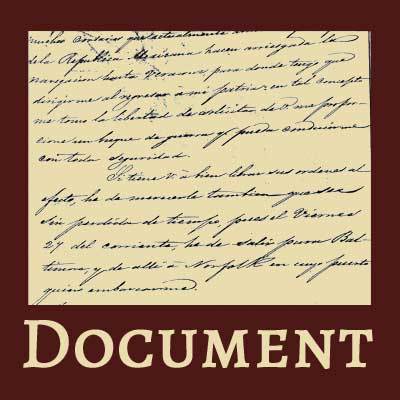
The journey was part of a long and complicated diplomatic struggle involving the United States and Mexico over Texas.
When Mexico gained independence from Spain in 1821, it included Texas and much of the present-day southwestern United States. The United States had coveted Texas for some time, and since 1800 filibustering expeditions (essentially, private armies) had entered Texas, looking to wrest it from the Spanish Empire. The United States had claimed Texas as part of the Louisiana Purchase, but gave up its claim with the Adams-Onís Treaty of 1819—in exchange for Spain ceding Florida to the United States.
After Mexico’s independence, however, many in the United States argued that the Adams-Onís Treaty no longer applied. Meanwhile, settlers from the United States flocked into Texas. The United States attempted twice to purchase Texas, in 1825 and 1829, but Mexico would not sell.
The outbreak of the Texas Revolution in 1835 put the United States into a bind. Officially, the administration of President Andrew Jackson—who hoped to add Texas to the United States—remained neutral. However, U.S. citizens poured over the border into Texas, looking for various combinations of adventure, land, and what they perceived as a fight for liberty. U.S. army troops, massed near the border, did nothing to stop U.S. citizens from entering Texas. Citizens held meetings throughout the United States to raise men, arms, and finances for the Texas Revolution. Diplomats from the Texas cause, then the Texas Republic, worked in the United States to encourage support for the rebellion, while Mexican diplomats fervently worked to prevent support and, at the very least, to remind U.S. officials of the country’s strict neutrality laws.
After the Texan victory at San Jacinto on April 21, 1836, Texas Republic diplomats continued their work, seeking recognition, while Mexican diplomats worked to prevent recognition. In late 1836, another Texas diplomatic delegation prepared to embark for Washington. Its mission: to secure arms for defending against a future Mexican invasion, and to secure diplomatic recognition, and even annexation into the United States, from the Jackson Administration. Congress debated the issue of recognition repeatedly, as the United States’s battle over slavery—an issue in the Texas Revolution—became a focus for public discussion of the Texas issue.
But this diplomatic delegation was different from the others. In addition to three Republic of Texas officials, it also included Santa Anna and Almonte. The Texas Republic had figured out how to whisk Santa Anna out of Texas...
Further reading: